Rising Damp Ipswich connects owners of older Ipswich homes with independent, QBCC licensed damp specialists. We start by working out whether what you have is actually rising damp — in this city it is very often condensation, a drainage fault, or a room that was built in underneath a Queenslander without a damp course.
Talk it throughTell us what the wall is doing.
We connect Ipswich property owners with independent damp specialists holding the appropriate QBCC licence. We are a referral service and do not carry out the work ourselves.
Rising Damp Ipswich arranges damp assessments across Ipswich and the western corridor. This page is about rising damp in Sadliers Crossing, QLD.
An even horizontal line, usually somewhere between 600mm and 1.2m above the floor, on a ground floor wall. It marks the height where water stops climbing because it evaporates as fast as it arrives. Condensation and leaks do not draw a level line.
Salt left behind when the water evaporates out of the wall. It can look like a dusty white fur, or like crystals in the mortar joints. It often looks worse in a dry week, which confuses people, because dry weather is when the evaporation is fastest.
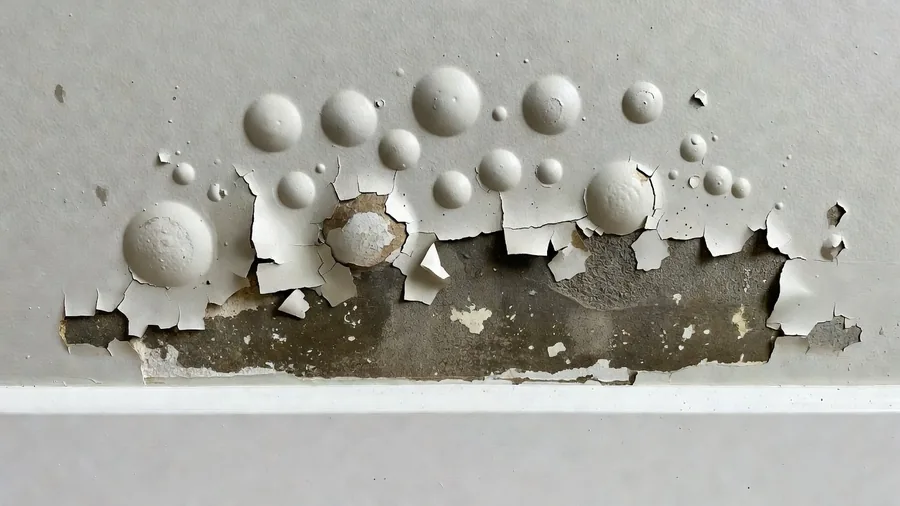
Not a bubble in one spot but a strip of blistering that follows the same height along the wall. Modern acrylic paint on an old solid wall traps water behind it, so the paint lets go before the plaster does.
Timber in contact with a damp wall swells, then rots from the back. A skirting that gives under a thumbnail while the face still looks sound is a good early sign, and it is the one most often painted over rather than investigated.
Particularly in a room that has been built in underneath, or a front room that gets no sun. The smell arrives before the staining does, and it is the reason a lot of people ring in the first place.
The ceiling is dry, the top of the wall is dry, and the damage is all in the first metre. That distribution is the strongest single indicator that water is arriving from below rather than from a roof, a gutter or a pipe.
Sadliers Crossing is workers' housing from the railway years, small cottages packed close on narrow allotments. Many are timber on low stumps, which sounds like an exemption from rising damp and is not: the stumps are short, the underfloor is tight, and where a later concrete path or slab has been poured against the bearers there is a direct wet path into the frame.
Two very different houses share these streets. The original timber cottages take damp through their subfloor rather than their walls, and the symptom is a soft skirting or a musty smell rather than a tide mark. The brick cottages built alongside them behave conventionally. Telling which one you own decides whether the answer is ventilation or a damp course.
The suburb slopes toward the rail corridor and the ground between the houses is flat, close and shaded. Narrow side setbacks are the specific problem: a metre of permanently damp soil between two buildings never dries, and the wall it touches never gets the sun that would otherwise carry the moisture back out.
Ipswich has a humid subtropical climate with most of its rain arriving between November and March, often in heavy falls rather than steady drizzle. That pattern matters for damp in two ways. Ground that is saturated repeatedly through a wet summer keeps a wall wet long enough for water to climb it, and the same humidity produces condensation on cool internal surfaces through the cooler months. The two look alike to an owner and behave completely differently. A wall that is worst in February and improves by August is behaving like ground water. A wall that is worst on cold mornings, in a bathroom or a closed-up room, is almost certainly not.
In Ipswich the honest first answer is often no. Condensation, a shower leak, a failed downpipe and reactive clay all produce a wet wall, and none of them is rising damp.
Pre-1900 solid masonry usually has no barrier. Interwar brick usually has a bitumen one that is now old. Anything on a modern slab has a membrane and is not a candidate.
If the property has been through 2011 or 2022, some of the salt in that wall arrived from the river, not from the ground. That changes the treatment.
A chemical course injected into the mortar bed. It stops new water climbing. It does nothing about the water and salt already in the wall.
The full sequence, and why the order matters in Sadliers Crossing, is set out on our how it works page.
Rising damp is ground water climbing a wall. Everything else - the salt, the lifting paint, the smell - follows from that one fact.
This is the most common version of rising damp in Ipswich, and it is created by a renovation rather than by the original house.
Ipswich is the oldest provincial city in Queensland, which means a share of its masonry predates the damp proof course entirely.
A damp course is not permanent. The two materials Ipswich houses actually have fail in completely different ways.
This is the most common misdiagnosis in South East Queensland, and it goes both ways. Plenty of rising damp gets dismissed as condensation, and a great deal of condensation is treated as rising damp at considerable expense.
If your property has been through 2011 or 2022, this question has to be answered before anybody quotes on a damp course.
Where a built-in-under room is the cause, the numbers change again. Sometimes the answer is a barrier in the new blockwork; sometimes it is ventilation and drainage and no barrier at all. That is decided at the assessment, and it is the reason we will not quote a treatment over the phone.
Indicative ranges for damp work in Ipswich, so you can sanity-check a quote before you accept it. Every fixed price follows an on-site assessment, because the two things that drive the cost — wall construction and how much render has to come off — cannot be judged from a photograph.
| Work | Indicative range | What it covers |
|---|---|---|
| On-site assessment and written diagnosis | $450 plus GST | Readings taken at intervals up each affected wall, an external check of ground levels, paving, downpipes and any built-in-under work, and a written finding. Where there is cracking it also says plainly whether what you need is a damp specialist or a structural engineer. |
| Chemical damp proof course, injected | $180 to $320 per linear metre | Drilling and injecting a cream or fluid barrier into the mortar course, then making good. The range depends on wall thickness, whether it is single or double skin, and access. A solid nineteenth century wall costs more than an interwar cavity wall. |
| Salt-affected render removal and replacement | $120 to $260 per square metre | Taking off contaminated render and plaster, allowing the wall to dry, then re-rendering in a system that lets the wall breathe. This is usually the larger half of the bill and the half people do not expect. |
| Subfloor ventilation to a Queenslander or built-in-under room | $1,800 to $4,500 | Additional vents, or powered extraction where the underfloor cannot be ventilated passively. Often the entire answer on a timber house, where no damp course is involved at all. |
| Drainage and ground level correction | $900 to $6,000 | Lowering garden beds and paving away from the wall, correcting falls, and taking downpipes into a line rather than discharging at the base of the building. Frequently the cheapest item on this list and the one that does the most. |
Prices are indicative ranges only. Every fixed price quote follows an on-site assessment.
Almost certainly not. A modern slab has a membrane under it and the brick skin stands clear of the ground on its own edge beam. There is no route for ground water. A wet wall in a house that age is a leak, a shower, a drainage fault or condensation, and you need a different trade.
Timing and shape. Rising damp is worst through the wet summer months, sits in the first metre of the wall and draws a level line. Condensation is worst on cold mornings, appears on the coldest surfaces in the room, often high in corners and around windows, and does not respect a horizontal line. In this climate condensation is the more common of the two.
No, and it matters. Flood water saturates a wall through its full thickness and leaves salt behind at whatever height it reached. That damage can look exactly like rising damp years later. The difference is that flood salt does not need an ongoing water source, so installing a damp course will not fix it. The salt has to be drawn out of the wall.
Usually not directly. Much of Ipswich sits on reactive Walloon clay, which swells when wet and shrinks when dry, and that movement cracks render. A crack then lets water in, so you get a wet wall — but the mechanism is movement, and injecting a damp course will not stop it. A stepped crack through brickwork should be looked at by a structural engineer before anyone quotes on damp.
Tell us what the wall is doing. Tell us what the wall is doing and roughly when the house was built, and we will put you in touch with an independent Ipswich damp specialist. If it sounds like condensation or a drainage problem rather than rising damp, we will tell you that instead of arranging a quote.
We connect Ipswich property owners with independent damp specialists holding the appropriate QBCC licence. We are a referral service and do not carry out the work ourselves.

We take enquiries across the Ipswich local government area and the western corridor.
 Rising Damp Ipswich